• About

TheCornerEnd

  • aVoL-Resilience, “self”

    April 6th, 2024

    To implement strategies that achieve and maintain equilibrium in life, a good place to start is with ourselves. Not all stress creating situations are down to us, but the responses to them are.


    Understanding our make up – the stressors that impact us negatively, the situations that create anxiety, our reaction to people who rub us up the wrong way, our own personal vulnerabilities that create issues for us – is the first step in developing both avoidance and coping strategies.

    Self analysis can be difficult, exploring personal traits and identifying areas we can do better can be uncomfortable. To make it more palatable agree a contract with yourself. The process is about awareness, not self criticism ; it is personal and does not need to be shared; it is not intended to be intense nor destructive; the goal is to identify minor changes in your approach to life that improves your wellbeing.

    You are you. There is little point in trying to be someone else, but adopting some small changes can make a big difference – and small changes are easier to implement and make stick. Over time, small changes accumulate to a big change, so be patient and persevere.

    So give it a go. Simply invest an hour or so and generate a list of all the things that create negativity, anxiety or stress in your life. For good measure throw in a few things you know you can personally do better. Nothing is too trivial. Then leave it. Come back to it later – think about it a while, mull it over. The starting point for the first small change will probably be obvious to you – it may be the most urgent thing you face or perhaps the most frequent ‘annoyance’ you encounter. In any case work out what you want to do about it – and do it. Soon you will appreciate that most of what creates anxiety for you can be minimized or removed.

    After a period of time revisit your analysis and make an assessment of what if anything has changed. And what has been the impact of this change? This can be as simple as you want it to be – am I feeling better? – am I being more effective? – am I more consistent and balanced? Do I feel happier; more content; more in control? Just answer the question that is most pressing to you. And again, it’s only for your consumption.

    Over time it will become much clearer about whether the issues in your life are self generated or whether they are a result of others actions impacting you. Probably a mixture of both. The harsh reality of life is that there will always be issues to deal with, experiences we have never encountered before that challenge us, situations that create anxiety – learning to deal with these is a valuable life skill.

  • aVoL- Resilience, the preamble

    March 9th, 2024

    I think I am just like the vast majority of people on the planet in that I prefer to live my life in the comfort zone where the pressures of modern day life are balanced by my ability to cope. I am ok with the odd period of stress (stretch) and really enjoy those occasions of total calm.It has not always been so – throughout my life I have endured prolonged periods of immense stress – unpleasant memories which are rarely visited. However, the upside of this is that I have learned valuable coping skills and realized that resilience is not a genetic thing (although personality traits are a factor) but it can be learned.

    As every decade passes, the very act of living becomes more difficult. The pressures on personal resources and choices- time, money, relationships, careers – is intensifying. “Society” appears to be raising the expectations of what life should encompass and the timescales to achieve “success” (some ill-defined notion) reducing with each generation. The pace of change- technology, social norms, financial hurdles, moral standards- is accelerating, often outstripping individuals’ ability to develop the tools to live in this modern world.Support systems- education, social infrastructure, health services, family and community – are also under pressure, if not being undermined and eroded.

    The consequences of this is that lots of people are struggling to enjoy a normal life.Things which were once deemed to be taken for granted- a solid job, career, own home, financial stability, a sense of purpose – are starting to seem somewhat elusive. The subject of mental health, not so long ago a rare topic of discussion is now regular front page headlines. It touches all generations from the impacts of schoolchildren being cyber bullied through to senior citizens not being able to afford to leave work and enjoy retirement.

    If you work on the assumption that the more in control your life is, the greater the chance that you will be happy, then the objective should be to achieve homeostasis- basically despite all that is going on around you, good, bad or indifferent you manage to achieve an equilibrium- balance. Applying scientific principles to the human emotional state then it is possible to move towards equilibrium. Newton’s 3rd law of motion states that for every action there is an equal and opposite reaction, hence if some action is resulting in a negative effect on your life then there has to be a counteraction to mitigate this impact. Stressors result in negative impacts and resilience forces help counter them- hopefully achieving balance.

    Stressors come in three categories – those that are self induced; those that are a result of external forces; those that occur when things just go wrong. So taking money as an example, financial duress can arise because of self induced profligate spending resulting in unmanageable debt; an external force could be a big hike in interest rates which increases mortgage payments resulting in financial hardship; things going wrong could be the engine of a car blowing up with a subsequent large unforeseen outlay. 3 different scenarios -same impact. Resilience forces that could be applied to this situation are twofold. The first set are proactive that anticipate some unknown event, the second are reactive aimed at the issue in hand. Both have value.

    The common stressors that are apparent in today’s world include money, time pressures, job/careeers, life expectations, relationships , health….. All these are swilling around in a world where there is geopolitical instability, international conflicts, national division and polarization and where personal aggression is becoming accepted as the norm. Difficult and uncertain times.

    A note of caution. I am not a medic or a therapist. I am not a miracle worker who can solve world hunger. I am neither perfect nor a perfectionist. What I am is an observer of life, a bit of a thinker, someone who has experience and tried to learn on this journey through life. I am a lay person but have a voice and offer up thoughts in the hope that they strike a chord and may provide some benefit to readers of TheCornerEnd. TheCornerEnd is not a substitute for those who need specialist help with deeply difficult situations..

    We are all unique and respond differently to everyday situations hence approaches to these are likely to be very personalized. Control of our lives starts with each of us – but there are some general principles that apply to us all.

  • Easy Learning

    February 17th, 2024

    A great characteristic about human beings is we generally enjoy talking about the subject we know the most about – ourselves! Hence, presenting a great learning opportunity.

    If you have a job, then there is the opportunity to learn something every week of your life. It costs no money, takes very little time, comes with zero stress, does not require sitting exams or writing dissertations and is cumulative in nature. Life long learning?

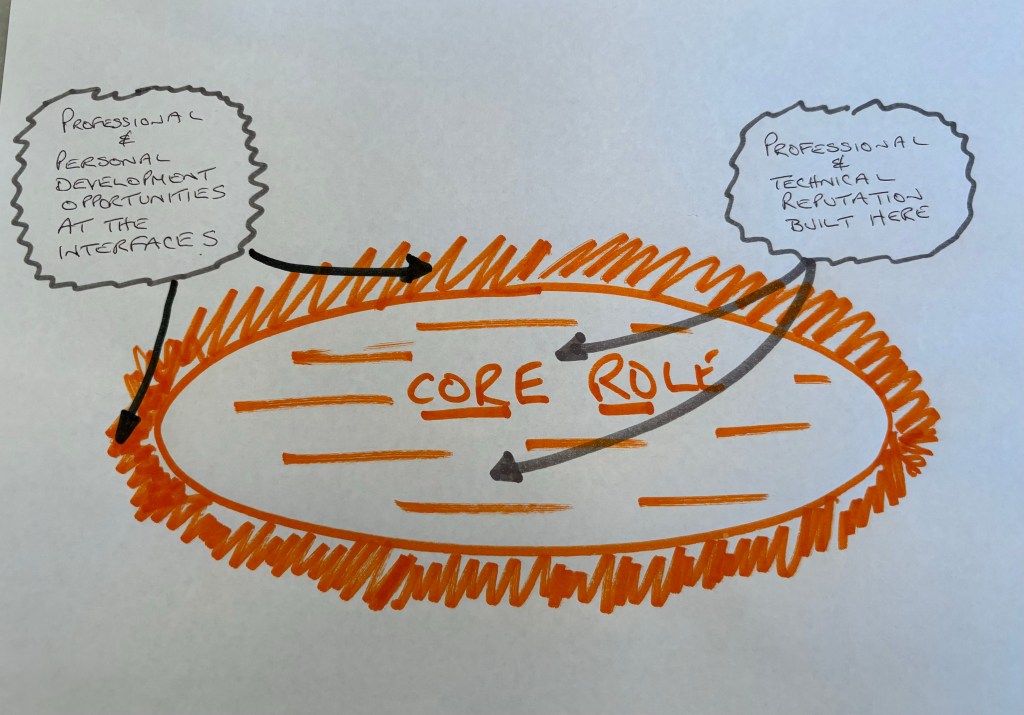
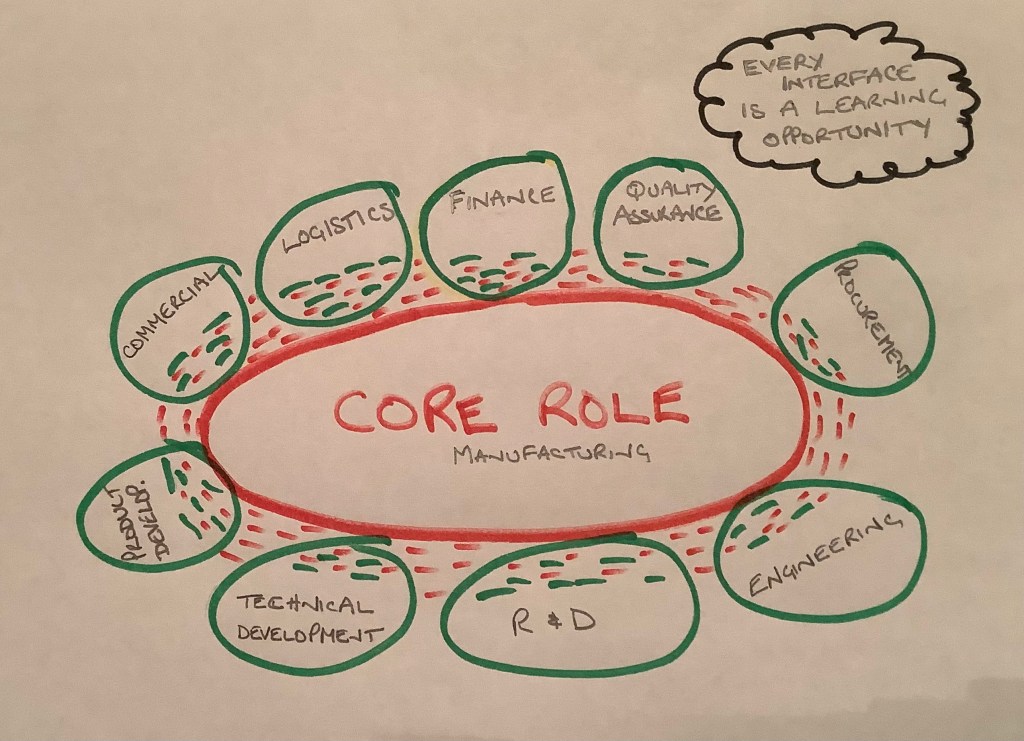
    Whatever your job, you are likely to have a defined role with designated responsibilities. The execution of this core role and delivery of associated business metrics will help you build your professional reputation. The opportunity for this continuous learning though sits at the interfaces of your role with the rest of the business – internally, but also externally with business partners.

    The company I worked for had a pretty good training program but it was not comprehensive and there were significant gaps. I was swimming in a strong graduate pool so to give myself an edge I decided to fill these gaps informally. The most pressing gap for all of us was financial management. Enter Arthur Proctor and John Cragg. Arthur was the site Chief Financial Manager and John the head of fixed assets. I went to see the secretary of the Finance Dept ( the gatekeeper) and asked if I could have an hour of their time – a simple request- to understand their roles. Apparently, this was an unusual situation as they were both 20+ year senior managers and I was still wet behind the ears. The time with Arthur expanded to 3 hours, with John 2 hours. Personal tutorials that covered P&L, balance sheet, fixed and variable costing, budget planning, variances to standard, capital projects and depreciation and transfer pricing. A terrific foundation.

    Two years later I was interviewed for a role in HQ – a role that I never even knew existed and a role that would totally change the trajectory of my career. The preliminary interview was quite heavily skewed towards business finance. Enough said!

    A simple question, an interest in what people do and how they do it, the innovations that are happening in their field, their perspective about current events……….. this simple process stood me in good stead throughout my career and beyond.

  • Mistakes

    February 15th, 2024

    We all make mistakes – it’s just a part of living! Assuming that these mistakes are not truly serious, life changing ones, then what separates us is how we deal with them. Dealing with the consequences of mistakes, learning from them is both character forming and broadens our experience base. Not acknowledging or dealing with them is character defining, leading to the impression of unreliability or not caring.

    Adequately putting a mistake behind us is a good thing- prolonged dwelling on them can negatively impact our psyche and ultimately our wellbeing. Words, actions and decisions cannot be undone, mistakes can be emotionally stressful but they can be dealt with- the process is quite straightforward once the resolve is made. There are a number of considerations –

    • Its nature? Does it only affect me; are others impacted; are there relationship issues; financial impact…etc.
    • What is its magnitude? Putting it in perspective is important. If it is a critical one can it be discussed with a neutral third party or some suitably qualified individual?
    • What was the root cause? Poor decision making; insufficient understanding; lack of information; third party influence? This is the heart of the learning process
    • Can its impact be rectified, repaired, minimized? What actions need to be taken if any?
    • Digest the output of these considerations and decide whether some intervention is appropriate- as opposed to “letting sleeping dogs lie”. After further reflection take the necessary actions.

    Perhaps an apology is required, some modification to our behavior, rethinking our approach to certain aspects, taking advice, improving analytical skills and decision making …. etc. Maybe it is just a case of swallowing hard and accepting the consequences.

    One point to be very clear upon is not to compound the mistake in anyway – through denial, procrastination or taking ill-considered action. Repeating the same mistake over again is not good as this is becomes perceived as a character trait.

    Perhaps the best thing to come from a mistake is the awareness and learning associated with its remediation – people normally feel positive towards those who acknowledge and deal with error. The easiest, least painless way to learn from mistakes is to learn from those made by others. If you can help others learn from your mistakes then that is also a positive.

    Of course, being able to deal with mistakes is strategically important, personally, with respect to fulfilling our life’s direction. People may limit themselves, not challenge themselves or take up opportunities for fear of making mistakes. This becomes less of an issue if you are comfortable in dealing with them.

    For organizations, creating a culture of ambition, innovation and progress is crucial and nothing kills it quicker than ridiculing mistakes and generating a fear of failure. Those capable of handling situations when things go awry are often the role models for future success.

    For my part, I have learned about

    • the value of personal protective equipment (PPE) by forgetting my shin pads as an 8 year old
    • investing by making ill considered decisions and losing money
    • strengthening the relationship with the most important people in my life by listening and saying sorry
    • becoming a better manager and leader by making mistakes, listening to feedback, accepting mentorship and recognizing “ I don’t know what I don’t know “

    To be sure none of us are done with making mistakes but we can try to minimize their frequency and consequences and maximize our learning as we continue our journey through life.

  • a View of Living (aVoL)

    February 13th, 2024

    A good many years ago, as I was working up a plan for both a business and personal transition, I worked closely with Julian Russel, a well respected consultant and life coach. Julian introduced me to the work of David Whyte, a poet, thinker and public speaker – specifically “The 3 Marriages” . The marriages themselves referred to love (relationships) , work and self and the notion proferred was that these dimensions pretty much encapsulated our lives.

    The more I thought about this the more interesting this idea became – not in a theoretical sense, but more practically, using the model to direct my future life plan. I tried to fit my short term aspirations and activities with this model but it just did not quite gel. Promising – granted, but just not there. Then I realized there had to be a fourth dimension - “ the world”. Now it made sense!

    Since then,I have adopted and further refined this notion to the point that it pretty much drives the way I live my life. Its application has helped me deal with some big issues, make better decisions , focus on what is important and help to keep things balanced and in perspective. Life is a bit more controlled as the framework helps me to better allocate my most valuable asset – time – the only thing you can never get back.

    The four dimensions I work in, and their relevance to me are “work”;” family, friends and community(ffc)”; “self “; and “the world”.

    “Work” – at its most basic, a way to be financially self reliant. However, its value can go way beyond money, providing many more opportunities to enrich yours and others lives.

    ”Family,friends & community” (FFC) – a shared journey through life where real meaning can be found, life long memories generated, legacies established. Also a place where life’s greatest challenges may be encountered.

    ”Self” – maintenance, recuperation & growth. Reflection. The only place where absolute honesty resides – difficult to lie to yourself.

    ”World” – awareness provides context , creates perspective. Understanding helps better decision making.

    Looking at life through this lens has a number of positives. It facilitates conscious analysis of allocation of personal resources – prevents drifting into, and residing in, areas that do not support your life’s purpose. It helps to ensure that you do not over promise your time and subsequently disappoint – safeguarding your reputation. It can assist in finding a pathway to achieve long term strategic objectives whilst ensuring that the absolute need to respond to immediate important issues can be accommodated.

    Work – life balance ceases to be a conflict, work is part of life, life is enriched by work. By recognizing that life has many facets, the trade-offs between these and work result in softer interfaces – refreshing self, understanding the world – have benefits for the workplace. You bring your personal values to work, others benefit from that, just as you benefit from experiencing their values. Work allows you to develop skills that also make general living easier and more fulfilling. Referencing all the dimensions of life allows the process of prioritization to be more effective – bringing the understanding that your daughters hockey match may be more important than a work telecon, whilst also recognizing that a key business project in crisis needs your full and immediate attention. A quid pro quo can be easily established.

    There is no fixed model on how much time you spend on each facet of living. The model is dynamic and flexible – and can evolve as new experiences shape your life’s philosophy.It can help you through times of crisis and chaos, bring an element of control to your life and provide a platform for development and growth. It helps identify what can be delayed, be forgiven, without derailing your personal direction. 

    However, the most appealing aspect of the model is that it is unique – unique to you. It is personal, it is yours. As you evolve, so can the framework. You look at your life differently today compared to a decade ago; expect that in a decade’s time your circumstances will be different, so will your view of living.

    The purpose of this reflection? Well,I appreciate Nirvana will not exist in my world. However, I want the lows in life to be shallow and infrequent; the highs to be their corollary . Regrets – a few, but too few to mention . A satisfying life that creates lots of happy memories, with much to look forward to, whilst enjoying living in the moment.


  • Education – a gift.

    January 1st, 2024

    Sometimes, a disappointment for someone can be a positive for others. That is the way it was in our family. My mother passed the school board exam and went to grammar school. Her formal education was cut short due to her mothers terminal illness causing her to leave school to run the family home.

    Her opportunity denied, only increased the determination that the same fate would not befall her children. Without us knowing the reason why, my sister and I were supported in any endeavor that was linked to our education. Her encouragement to us was unbridled. Unusually for our community, a full set of encyclopedia Britannica was acquired, probably via installments, just after my sister passed the 11+ exam. I have fond memories of the hours spent leafing through those volumes.

    From this foundation came a desire to learn. Decades on, my simple thoughts about this are

    • an education is one of life’s great gifts, to be be accepted, appreciated, nurtured, expanded upon, but most importantly passed forward
    • curiosity is the catalyst to learning. A question asked is more valuable than a statement made
    • acquiring knowledge to gain qualifications is only a small part of the process. Understanding how we learn offers a lifetime of enrichment
    • an education is a foundation for life but it is passive- value is only created when you do something with it
    • learning is not free, it requires time and effort, but eventually it becomes a habit. The economics of learning are incredible

    Hall of Fame #1

    Lance Crass was my first science teacher. He made chemistry exciting just through his personal exuberance for the subject. Over time he instilled the discipline of science in us by emphasizing the verification of theory through experimentation. Proof!
    Before starting the organic chemistry modules he explained that this was a subject that could not be crammed for an end of term exam. It was an accumulation of knowledge built upon sequential understanding. Next weeks more complex lesson would be easier if the principles of this weeks lesson were understood. The first ever enunciation of the learning process!

  • Why “TheCornerEnd”?

    December 31st, 2023

    Back in the day, THE corner end played a central role in the life of a community.There were many corner ends in every town and village but only one mattered.It was situated where the main walkways intersected, the focal point.The place where friends, neighbours, workmates and acquaintances bumped into each other, smiled, passed the time of day, had a chat.The place where news was shared, opinions passed, advice given………but generally ignored.A place where experiences were shared and the world put to rights.

    The world moved on. Cars replaced shoe leather ; shops, commerce, and services moved out of town, life moved online. Town and village centres morphed. Communication channels re-engineered. Virtual replaced the physical. That human connection slowly evaporated. THE corner end just became another corner end.

    TheCornerEnd is a place where experiences are shared, thoughts captured, notions developed, issues raised – often without conclusion. The purpose is not to give advice but to provide stimuli for thought. Perhaps to provide an alternative view, provide options, but not seek consensus.

    Over my personal and professional life I have been fortunate enough to interact with many interesting and learned people, who have contributed positively to me. A lot of what comes next is a result of their wisdom. Thoughts are recorded here at a point of time but views evolve, perspectives alter, the world around us changes so that notions need to be reconsidered. I now think very differently than “ way back in the day”. I hope my curiosity never diminishes. So take what is offered here with the spirit in which it is given.

    You have a voice, develop and use it for the benefit of yourself and others. TheCornerEnd is my voice – if it is useful to you , great. If not, then just discard it.

    31-XII – 23.

←Previous Page
1 2

Blog at WordPress.com.


Loading Comments...
 

    • Subscribe Subscribed
      • TheCornerEnd
      • Already have a WordPress.com account? Log in now.
      • TheCornerEnd
      • Subscribe Subscribed
      • Sign up
      • Log in
      • Report this content
      • View site in Reader
      • Manage subscriptions
      • Collapse this bar